
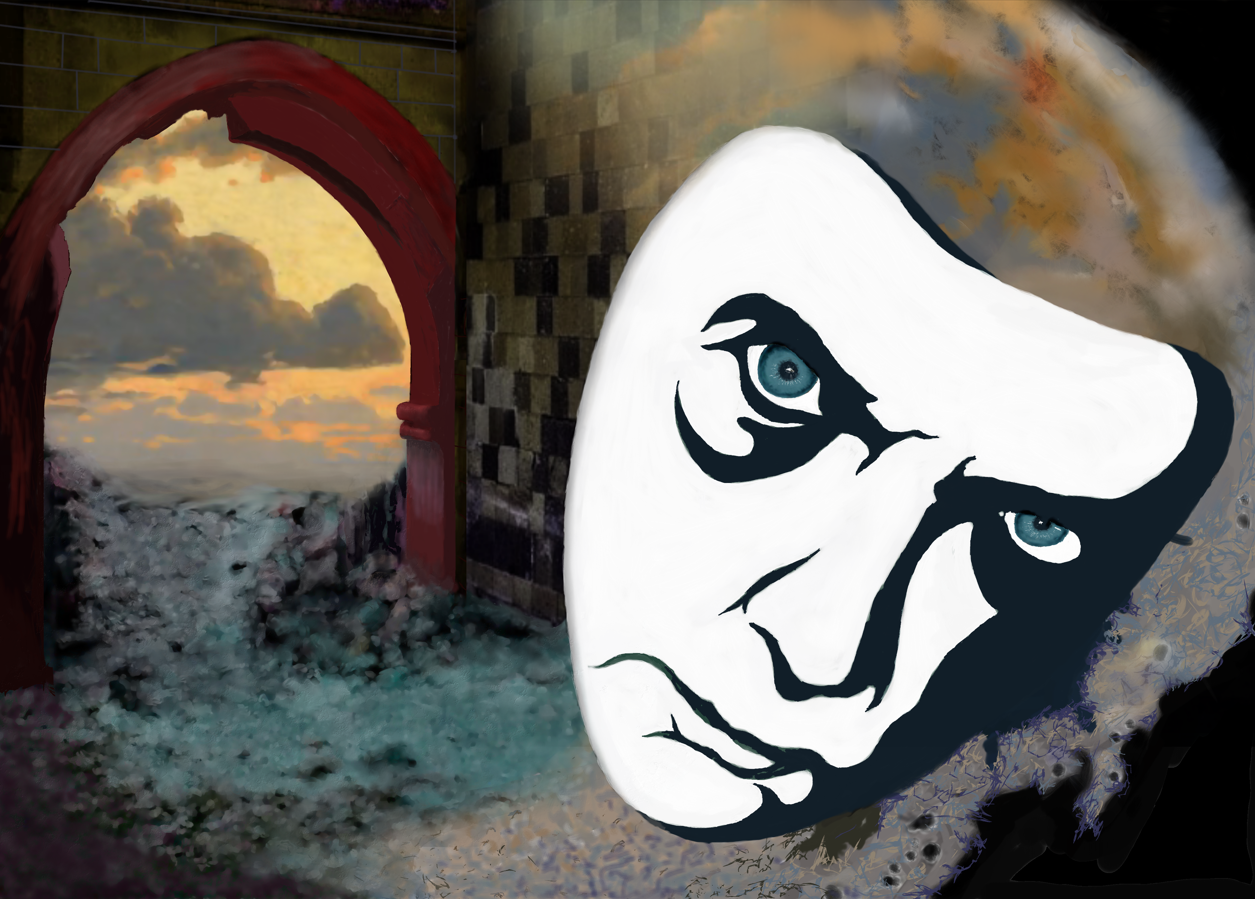
I’ve been giving a lot of thought recently to the concepts of persona and facade. Here are links to what Dr. Google currently has to say about a couple of aspects of those related ideas.
- In psychological terms what is the difference between the Jungian concept of persona and facade?
- Does the distinction between persona and facade diminish with age? (…asked the crusty retired gent)
Something that occurs to me about persona and facade in relation to the ideas Dr. Google presents is that persona emerges primarily as an unconscious reaction to recurring conscious input, and facade forms largely as a product of conscious intention. I say largely since it seems to me that I am psychically always in a liminal state … one foot in the unconscious and one in consciousness (and from moment to moment I’m almost always only aware of the conscious stuff). So every product of conscious intention (i.e., facade) rides on a layer of unconscious material, some of which, I dare say, might reasonably be thought of as unconscious motivation(s). Sort of the inverse of the formation of persona where the unconscious is the driver navigating where consciousness needs to go.
An obliquely related thought, at least in my mind, is an idea from a book I read at an impressionable age titled The Morning of the Magicians in which the authors assert that a man does not get what he deserves, but what he resembles. That train of thought visited me often during the weeks that I worked on the image above, which I developed using Corel Painter. That software allows computer stylus and tablet to be used in ways that somewhat simulate applying paint via brush to canvas. I especially enjoyed the shading and blending options very much, and I feel the approach allowed me to express myself in less literal (e.g., more fantastical) imagery than the photo manipulation software I have used so often in the past.
10/12/26 afterthought: Though “primary process thinking” and “persona” hail from the Freudian and Jungian Traditions respectively, as I look back upon my life many of my own actions in emotionally intense situations seem to me more reflective of Dr. Freud’s formulation than Dr. Jung’s.
Queen of the Underworld

I’ve been enjoying the extremely satisfying experience of my insides and outsides collaborating on the same project.
As I’ve droned on about at length elsewhere, I’ve been courting my unconscious, and in that service I’ve been thinking of my unconscious as personified by Persephone, Queen of the Underworld and the goddess of springtime, vegetation, and the cycle of life and death. The image above is the latest product of that suit.
I’ve long held that key decisions I’ve made while developing visual images were largely directed by unconscious dynamics. That instinct has transitioned into what feels like a pleasurable mental sensation. As if Persephone is responding to my attentions with abundant, increasingly robust input while I work, proposing prospects that might logically seem far afield from the matter at hand, yet stimulate arrangements of pixels that when implemented seem wonderfully right to me. And there is a feeling of tremendous satisfaction in rendering them.
And then there’s what happens when I stand back and consider an image I’ve rendered. For example, an association I especially enjoy about the image above is that Wikipedia informs me Persephone is holding a sistrum – a ritual rattle. A very long time ago … perhaps in my twenties … I recall visualizing an anxious “primitive” standing close to a small campfire holding a rattle. The fire, the human figure and what he’s holding is all that is visible. The rest is black nothing. I recall thinking, “Reason is a rattle we shake against the darkness.”
I think that memory crosses my mind at this time because I sense myself more and more willfully attempting not to work from a linear thread of reasoned intentionality. Instead, trying to organize pixels in expressions of associations. Then wondering wide eyed what potential meanings the image might suggest.