
Something I find especially annoying about the pace at which we are hastening to destroy ourselves is that things are just beginning to get SO interesting. Take, for example, the tragic/comic disconnect between our rush to self-destruction and our simultaneous surging self-awareness. Noodling over this irony is grist for no end of overtime churning in the gray matter.
At first glance I think it might seem reasonable to characterize self-destruction as bad and self-awareness as good. But it seems to me that self-awareness is not entirely rosy, and may even be a phenomenon that is, on balance, more dark than light. Specifically, I think self-centeredness, the prodigious malformed offspring of self-awareness, is the powerhouse driving our race to environmental and civilization collapse.
There’s a smorgasbord of world-ending options to ruminate over. Nuclear conflict, malicious use of artificial intelligence, the rise of unchecked paranoid authoritarianism. And, of course, the environment, regarding which I contend that the primary cause of global warming is the burning of fossil fuels like oil and natural gas. And global warming is the primary driver for the climate changes causing the devastation wrought by simultaneous monster hurricanes, rising seas, dying glaciers and rainforests, life threatening heatwaves and droughts, and unprecedented wild fires and flooding. At the same time the global markets, lots of politicians and millions of commuters enthusiastically await the resumption of the free passage of oil tankers through the Straight of Hormuz. I look at photos of the pre-hostilities armada of tankers transiting the Straight and think, “Are we out of our f***ing minds?” But then also I think, “No, we just really, really like the way we live.” And the civil leadership’s response to protests against our gluttonous consumption of eco-poisoning petroleum is almost universally, “Go away kid, you bother me.” End of thought. And consequently, end of story.
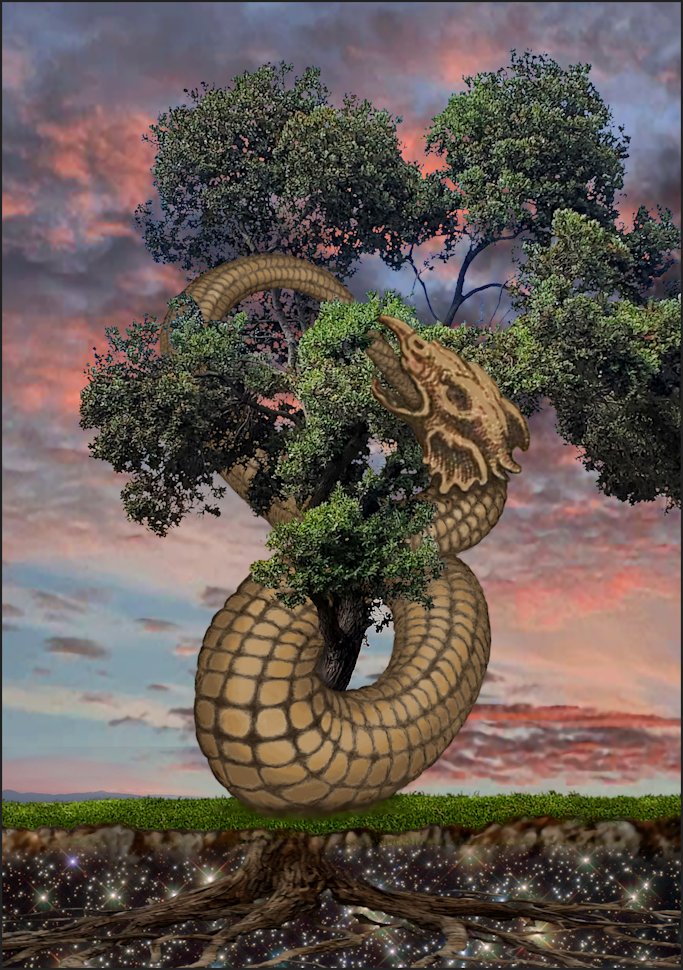
I came across the tree included in the image above in the median of a San Francisco boulevard. I liked the way the tree looked a lot and took a pic of it on my phone. I then thought of the tree often over the following eight weeks, considering how I might include it in a graphic. The image of an ouroboros serpent entwined in a figure eight around the tree became vivid in my thoughts.
As I worked on the tree and serpent a haiku-like verse I’d composed in early 2002 often crossed my mind.
deep gnarled roots entwine
what slumbers long forgotten
timeless in the earth
But it seemed to me that picturing whatever was slumbering would diminish its beauty. Rooting the tree in a star field then occurred to me. At that point I found myself interpreting the image that had emerged so far … something I try not to do … preferring to let the next “feels right” idea direct the composition, and mull over what it might be about at length looking back on the “finished” work.
The “self-destruction and simultaneous surging self-awareness” thoughts presented above pestered me. A blue sky with fluffy white clouds, which I’d briefly considered, came to feel grotesquely Pollyanna-ish. A foreboding sky felt right and I thought, “Life in the embrace of time, entering the twilight of eternal night.”
10/12/26 afterthought: There is something (perhaps one of several somethings) hinky about the concluding sentence above. In preceding paragraphs I’ve stated my understanding of one of my own habits of behavior to be that I try to move forward with the composition of a particular element of an image I’m developing because it “feels right.” And I’ve shared that I like to think that that feeling is significantly influenced by unconscious activity. Nonetheless, in the concluding paragraph above I confess that I went with a twilight sky because it seemed to me to support a very conscious interpretation I made while development of the image was still in progress … yet I stated that the twilight sky “felt right.” Hmmmm. Does blogger speak with forked tongue? An association that comes to mind at this juncture is thoughts I shared in a previous post about the concepts of persona and facade and the circumstances under which the distinction between those concepts fades.
Sculpted Forms
As I’ve droned on about in previous posts, I try with the graphics I develop to allow them to evolve as much as possible through uncritical acceptance and response to thoughts that spontaneously cross my mind while I work. My thinking is that such thoughts reflect unconscious intentions, and that by giving them visual expression I have an opportunity to examine and speculate upon what the greater portion of my psyche is up to. Most … perhaps all … of my previous graphic compositions have included overtly symbolic components which I have enjoyed ruminating over, all the while being careful not to hold on too tight to any particular interpretation that might occur to me on the assumption that if what I’m examining is indeed an expression of unconscious material its meaning can never fully be grasped … and that’s the bliss.
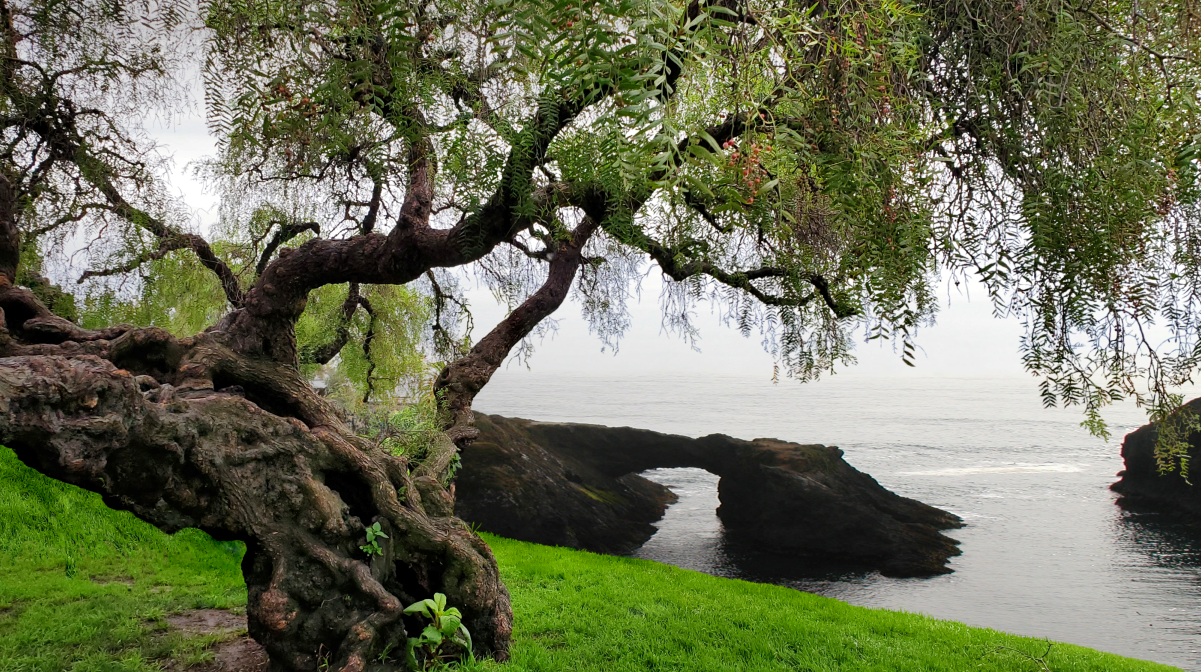
I tinkered with the image above for a little more than eight weeks. Off and on during the effort, in response to mild befuddlement at the emerging naturalistic scene I was authoring, I toyed with the idea of injecting some sort of mysterious element or other. Perhaps out there on the slope leading down to the ocean the shaman featured in a previous post might make an appearance. Or maybe three tall, lean pillars or stelae suggesting, in my imagination, a place of worship of the Fates. But every conscious (so they seemed to me) attempt at willful mystification I tried read as trivial Mickey Mouse distractions from what I was otherwise coming to appreciate as simply a pleasantly tranquil scene.
And now in the standing-back-from-the-work-and-considering phase, I wonder why I feel that pleasant tranquility is enough. In this instance, for me that seems to be the mysterious component. Perhaps the “big picture” is whispering … something I may not have really listened to before. Perhaps something like, if I let it, pleasant tranquility can be wrought through interactions in the world over time. Maybe a pointer to a potential upside of old age.
Temple Path
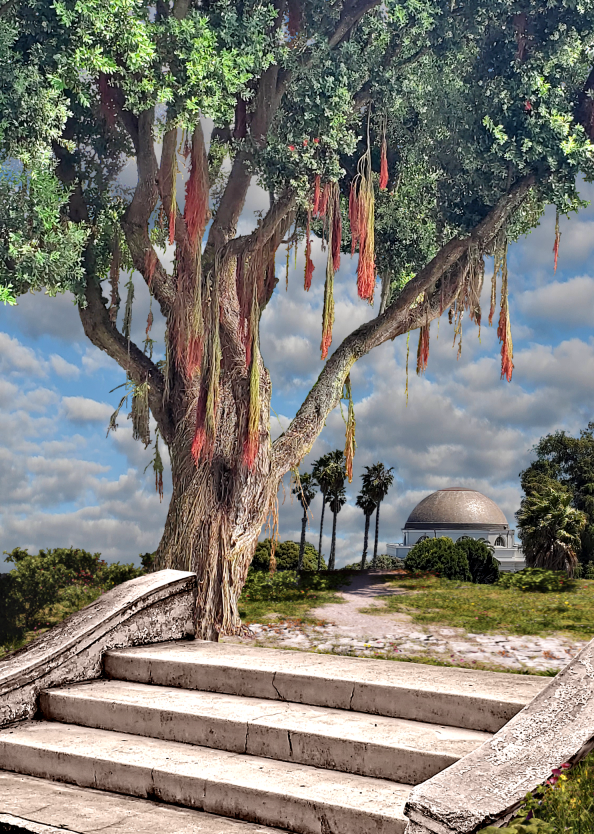
I completed the image above almost two months ago, but I did not post it until now partly because I sense it to be a departure from whatever I’ve been doing before. Or, to put it another way, it suggests to me a change has taken place, or is in progress. Something shifting in my response to the sense of mystery I relish in the world, and I’ve been at a loss about what to make of that.
The image is constructed from parts of six different photos. What kicked it off was the photo I took of the tree, which stands at the corner of Castenada and Montalvo Avenues in San Francisco’s Forest Hill neighborhood. Dr. Google tells me it is a Pohutukawa Tree, native to New Zealand, distinguished by its orange aerial roots. During the days of pleasant, meditative effort it took me to pull the tree, pretty much pixel by pixel, out of its “actual” Forest Hill background, thoughts about elements that might be arranged around it came to mind and the image above evolved.
When the assembly was complete, I liked it a lot, but I also began to feel that the aerial roots … the feature of the tree I found mysterious and had attracted me to it … seemed a bit of a distraction from what I came to feel was the overall tranquility of the scene. In my thoughts, on this occasion, the prospect of tranquility was eclipsing mystery. That awareness seemed to me to be something I needed to reflect upon, and it was still on my mind yesterday when I came upon a couple of things while cruising the web that seemed pertinent in an oblique, associative thinking, sort of way. My relationship to mystery felt a shake.
In an interview with former NY Times art critic Roberta Smith, she remarked, “Artists cannot control the meaning of their art. They can’t possibly encompass it all if they’re good. There’s stuff left over for generation after generation to deal with.” I have no pretensions to artistry. Rather I think of the stuff I do, and the way I work, as an attempt to allow my unconscious self to find expression, and sometimes permit a glimpse of an internal horizon that is at once a little more distinct, yet ever retreating … chasing meaning of a sort that seems for a moment to be in my grasp, then skips teasingly out of reach again.
In December 1882, Vincent van Gogh wrote to his brother Theo, “Sometimes I long so much to do landscape, just as one would go for a long walk to refresh oneself, and in all of nature, in trees for instance, I see expression and a soul.” I think one of the things that especially drew me to that quote is that four weeks ago I began working on another image, and again the star of the show is a tree. This time one I photographed in San Francisco’s Dolores Park. Progress is slow because the shot includes a goodly expanse of the tree’s boughs with the sky visible through a gazillion gaps in the leaves. I’ve determined that I need to punch out all patches of sky from the tree shot so that the sky in the image I’m currently thinking of placing behind the tree will show through realistically. This sky-purging process, which feels meditative and I’m enjoying immensely, will likely take several more weeks. And it’s looking like the outcome will offer tranquility transcending mystery to an even greater extent than in the image above.
Hypnopompia
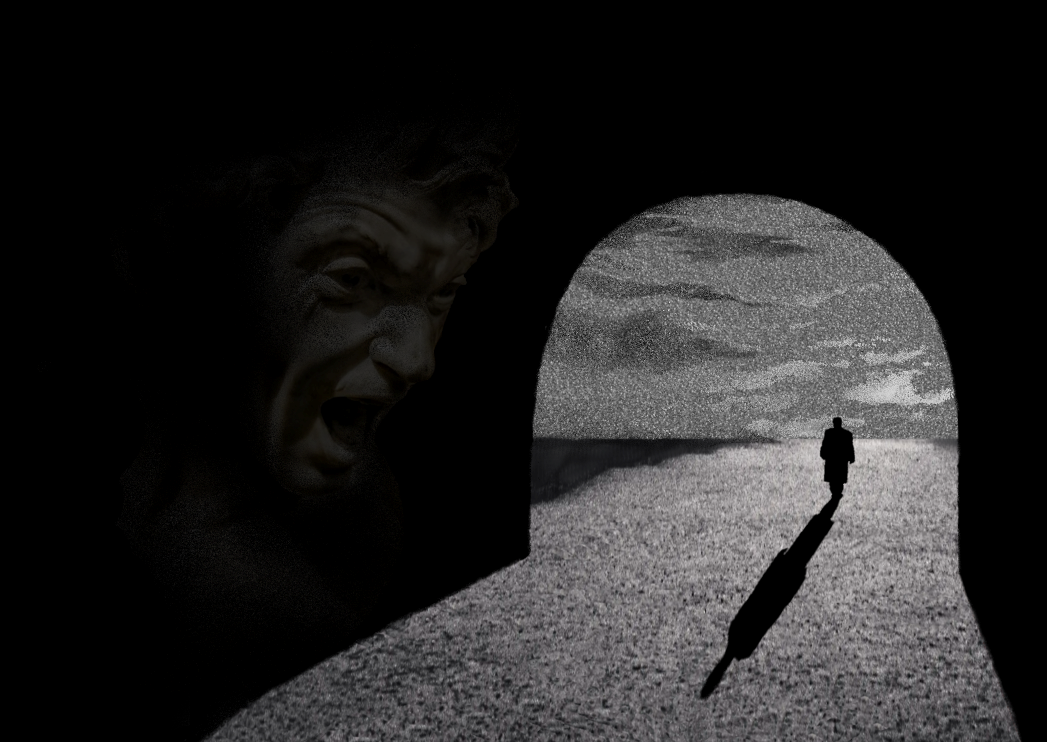
The composition above came together, first to last, during an eight-hour binge. The experience was for me, I think, sort of the graphic equivalent of automatic writing. Fragments of images and possible relationships between them presented themselves in an order that was easy to lay down. Like having stumbled upon a pleasant obscure text, I am contentedly at a loss regarding what it means.
Rebis
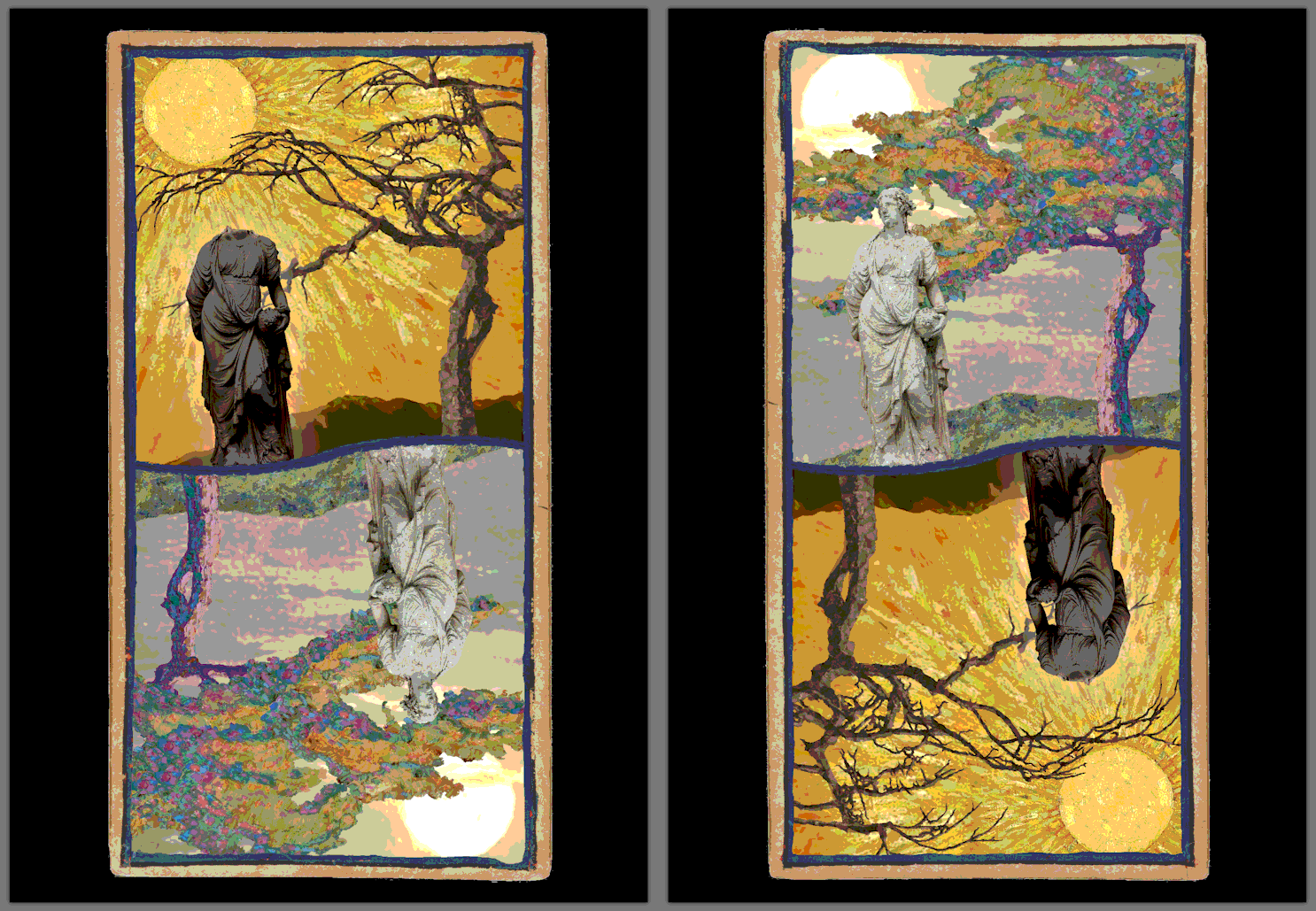
I’ve been thinking about the concept known as Rebis. In the Alchemical Tradition that word denotes the culmination of the “Great Work” … which includes the union of opposites. I don’t think there’s much chance of Rebis being achieved in actuality. And in the arena of the mind, I think it’s a wonderfully worthwhile project, but one that probably always proceeds one step forward and two steps back. I say this because the union-of-opposites-like enterprise I’m preoccupied with these days is enhanced collaboration of my conscious and unconscious faculties. And my experience so far is that the unconscious is vast, and by comparison consciousness is miniscule. Like the difference in scale between the earth and the entire rest of the universe.
An idea I’ve been toying with is that what I’m consciously aware of expands in response to experiences in actuality and as a consequence of contributions shared by my unconscious faculties, either while on the edge of sleep or as ideas that present themselves to me while I’m awake. Such day-time gifting usually takes place during moments when I’m not actively responding to a pressing need in actuality, or on those occasions when I’m engaged in some manual task like applying leaves to the tree in the image above. While performing almost automatic, largely repetitive actions with my hands, unsought ideas present themselves that often feel wildly out of left field and at the same time also wonderfully pertinent.
Shortly after I first began noodling over Rebis several weeks ago I happened upon a particularly wonderful Tarot deck called Visconti Sforza. I do not read Tarot cards myself, but I’m always grateful for the ideas that cross my mind when I look at them. While looking at the Visconti Sforza deck the “Rebis Card” above began to take shape in my thoughts.
High Retreat
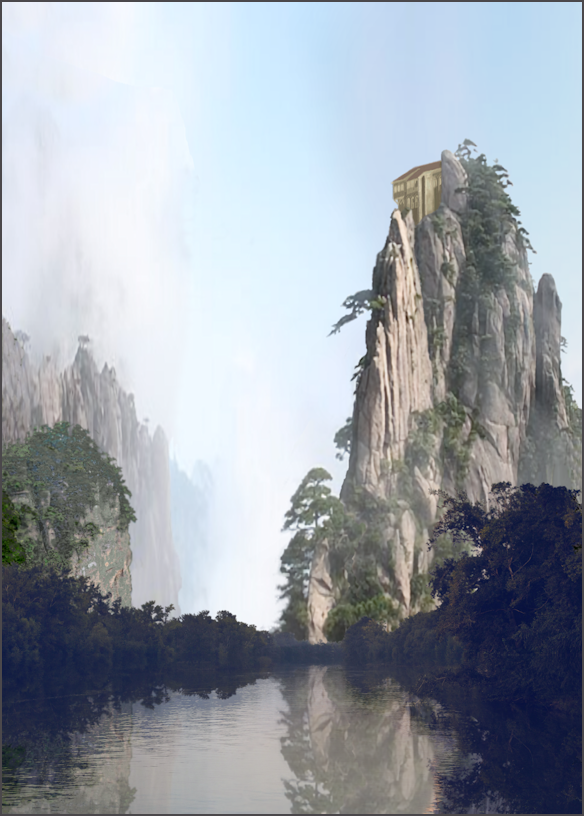
From time to time over several months, I dreamt an image very much like the one above. And subsequently on the edge of sleep, I began willfully visualizing myself there. Sometimes by the water. Sometimes walking among the trees. Sometimes within the structure high on the craggy peak, which I explore, or from which I simply look out the windows.
The image above is not an exact replica of the place I dreamt, but all the key features that were present are represented, and it captures the sense of scope and feeling of the original vista. The image above has since eclipsed the original in my thoughts, and offers itself as a highly accessible site for edge of sleep exploration.
Update 1/12/26: In my imagination on the edge of sleep I’ve built a small dock on the near side of the lake. That gets me out over the water, but not too close, as there are lots of large, strange beings, some perhaps uncordial, just below the surface. (I hope I can loosen up around that wariness as I acclimate.) And I’ve constructed a comfy wooden lounge-like deck chair where I sit on the dock under an awning, smoking a maduro-wrapped cigar, sipping a canned margarita, and admiring the view. I imagine when the weather turns, I may prefer to be in the structure on the craggy height … but maybe not. There are no shutters on the windows, so the wind and rain would certainly get in. The place could get super nippy and the wet stone floors would probably be pretty slippery. At the same time I’m not sure I’d want to install shutters since I like the way the place looks now very much. Of course, that may change.
Wild in the Temenos

The fantasy I associate with the image above is that I’m the personification of a people. We looked at the world and drew conclusions about how it works. The conclusions that aligned with our desires were refined and codified, and a physical structure was erected, expressing our orthodoxy in columns, arches, and domes.
But one night I dreamt that a great dark horse with a white star on its brow was running wild in the orthodoxy structure. And when I awoke, I was in a vast meadow. Waist-high tawny grass and the boughs of distance trees swayed and churned. The breeze chill on my face was sweet autumn scents and the stench of rotting flesh from an open trench that ran zig-zig to the horizon. There was the buzz of flies and bees, the caw of crows, the laughter of children and the howling of beasts. Shadows of clouds moved hugely over me, alternately cast by swaths of great white formations in an azure sky, then walls of black thunderheads. Light and dark. Light and dark. The earth beneath my feet cried out and there was a sensation in my being like the opening of a door. A wave of unorthodox conclusions about how the world works poured in.
Themis

The word liminal has been much in my thoughts. Dr. Google tells me it means, “occupying a position at, or on both sides of, a boundary or threshold.” In my most recent previous post I considered Persephone, Queen of the Underworld, who spends part of the year here and part of the year in the other place. And my understanding of my own situation as that of someone perpetually here and in another place, though directly conscious of the goings on in the other place only while on the edge of sleep … and then only through a marvelous lens of fantastic images.
I had read that because she simultaneously and perpetually knows what’s on both sides of the door, Persephone’s aunt Themis knows how it all fits together. As a consequence, because she knows the complete back story, Themis can sponsor oracles. She knows when something is right, and she knows when something is not as it should be.
Themis is also the mother of the Moirai (the Fates), of whom Wikipedia says, “The role of the Moirai was to ensure that every being, mortal and divine, lived out their destiny as it was assigned to them by the laws of the universe.” I think of them as the personifications of “what happens” — independent of ambition, hope, rationalization, best and worst intentions, and all other thoughts, isms or actions one might engage. They are how the cookie crumbles.
The other day I asked a pal what ideas she thought a parent might share with a child to help them face an environment and civilization that we’ve wrecked beyond repair. She proposed the phrase, “Life is not fair.” Upon reflection, I find that I’m entirely on board with that idea. The Fates come to mind, and it occurs to me that if a child asks, “But what do I do?! What do I do?!” I’d be inclined to suggest, “Be kind when you can. And be as happy as you can as long as you can.”
In the image above I’ve imagined Themis offering for our consideration thoughts from the Quran rendered in cuneiform that read:
When the heavens have
been rent asunder
And the stars have
been set to flight
When the seas have
been comingled
And the graves have
been upturned
A soul will know
what it has
sent forward
And what it has
held back
Queen of the Underworld

I’ve been enjoying the extremely satisfying experience of my insides and outsides collaborating on the same project.
As I’ve droned on about at length elsewhere, I’ve been courting my unconscious, and in that service I’ve been thinking of my unconscious as personified by Persephone, Queen of the Underworld and the goddess of springtime, vegetation, and the cycle of life and death. The image above is the latest product of that suit.
I’ve long held that key decisions I’ve made while developing visual images were largely directed by unconscious dynamics. That instinct has transitioned into what feels like a pleasurable mental sensation. As if Persephone is responding to my attentions with abundant, increasingly robust input while I work, proposing prospects that might logically seem far afield from the matter at hand, yet stimulate arrangements of pixels that when implemented seem wonderfully right to me. And there is a feeling of tremendous satisfaction in rendering them.
And then there’s what happens when I stand back and consider an image I’ve rendered. For example, an association I especially enjoy about the image above is that Wikipedia informs me Persephone is holding a sistrum – a ritual rattle. A very long time ago … perhaps in my twenties … I recall visualizing an anxious “primitive” standing close to a small campfire holding a rattle. The fire, the human figure and what he’s holding is all that is visible. The rest is black nothing. I recall thinking, “Reason is a rattle we shake against the darkness.”
I think that memory crosses my mind at this time because I sense myself more and more willfully attempting not to work from a linear thread of reasoned intentionality. Instead, trying to organize pixels in expressions of associations. Then wondering wide eyed what potential meanings the image might suggest.
Facade and Reflection
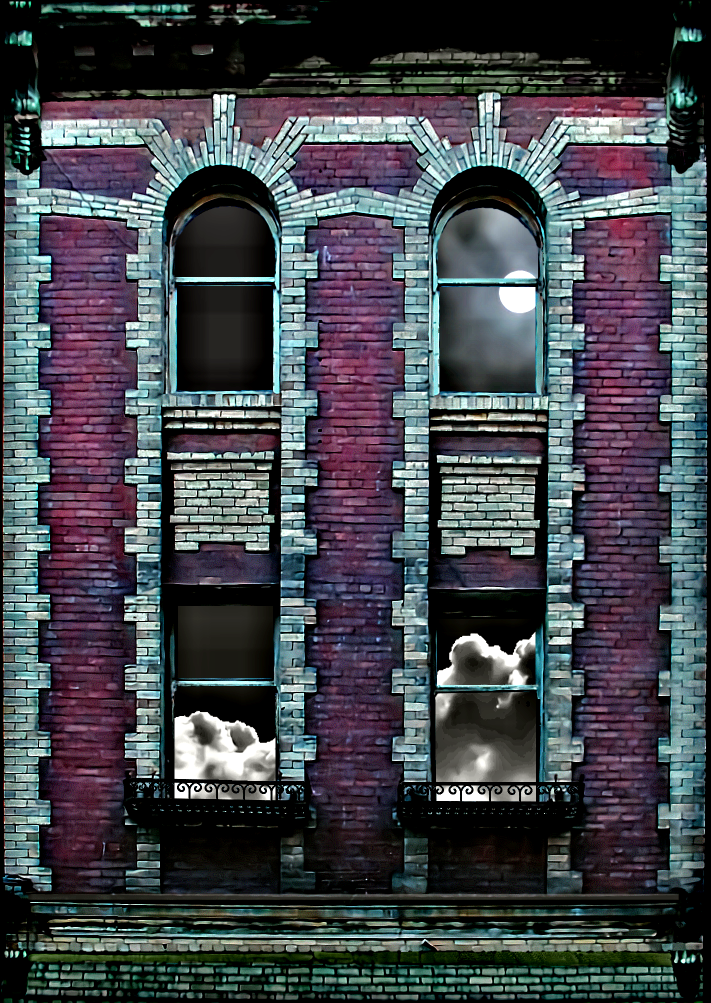
The façade pictured in the image above belongs to the second and third floor of a building on Grant Avenue in San Francisco which I photographed in February 2003. That façade is NOT an element of the lovely Peabody Hotel in Memphis, Tennessee, at which I had the pleasure of helping to stage a conference in the 1980s.
A fun attraction of the Peabody continues to be the twice-daily march of the Peabody Ducks to and from a fountain in the center of the hotel’s main lobby. Another fun but lesser-known uniqueness of the hotel is the “Lead Duck” pin. If you are wondering what a pin made of lead and shaped like a duck could be about you are already leaning in the direction I hope this post will take you.
The pin is given to key folks who are participating in the staging of an event at the hotel. It lets the hotel staff know that the wearer is to be accorded special assistance if requested because they are an event lead…er. Pleasantly aware that “lead” has at least two meanings, and potential humor can arise from a meaning switch, when the hotel’s delightful convention manager presented me with my pin she declared me a “Lead Duck” – pronounced “led” as in the heavy, bluish-gray, soft, ductile metal. I remain very amused.
I love words that can mean more than one thing. From words soulful like tear, to words colorful (another word that also has a couple of meanings) like booty. Which brings me to façade and reflection and the image above.
I think of my own experience of my own experience as a layer-like zone vacillating in a conical space between unconsciousness and consciousness. Imagine on the left side of the screen an immense globe of swirling unconscious material, each mote of which is related to every other mote by a gazillion associative connections. On the right side of that globe imagine a conical space…a transition area the base of which projects from and interacts with the swirling unconscious stuff. And emerging to the right from the apex of the cone is a line of thoughts, formed when the unconscious stuff moves and is processed through the cone into a linguistic-like conscious thread that allows me to purchase a jar of pickles, open it, and tell you about it.
Regarding that conical space, I think of myself as sort of a band or layer that moves back and forth between the unconscious base and the conscious apex. Often hovering nearer the base than the apex. Especially lately since I’ve been willfully courting a state that, with increasing frequency, allows what I see there to linger as images that can be recalled. Images from a depth within the cone that precedes the point where one or another related meaning gets designated as the next bead in the linier conscious thread – from a depth at which differentiation between things has not yet occurred.