
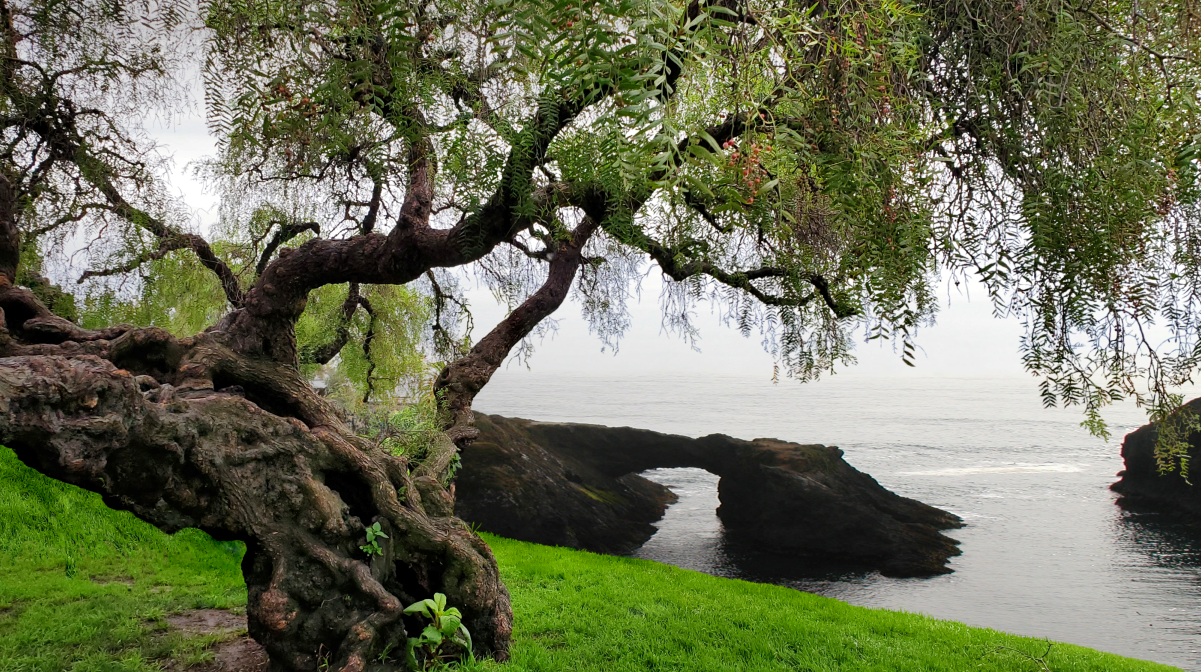
As I’ve droned on about in previous posts, I try with the graphics I develop to allow them to evolve as much as possible through uncritical acceptance and response to thoughts that spontaneously cross my mind while I work. My thinking is that such thoughts reflect unconscious intentions, and that by giving them visual expression I have an opportunity to examine and speculate upon what the greater portion of my psyche is up to. Most … perhaps all … of my previous graphic compositions have included overtly symbolic components which I have enjoyed ruminating over, all the while being careful not to hold on too tight to any particular interpretation that might occur to me on the assumption that if what I’m examining is indeed an expression of unconscious material its meaning can never fully be grasped … and that’s the bliss.
I tinkered with the image above for a little more than eight weeks. Off and on during the effort, in response to mild befuddlement at the emerging naturalistic scene I was authoring, I toyed with the idea of injecting some sort of mysterious element or other. Perhaps out there on the slope leading down to the ocean the shaman featured in a previous post might make an appearance. Or maybe three tall, lean pillars or stelae suggesting, in my imagination, a place of worship of the Fates. But every conscious (so they seemed to me) attempt at willful mystification I tried read as trivial Mickey Mouse distractions from what I was otherwise coming to appreciate as simply a pleasantly tranquil scene.
And now in the standing-back-from-the-work-and-considering phase, I wonder why I feel that pleasant tranquility is enough. In this instance, for me that seems to be the mysterious component. Perhaps the “big picture” is whispering … something I may not have really listened to before. Perhaps something like, if I let it, pleasant tranquility can be wrought through interactions in the world over time. Maybe a pointer to a potential upside of old age.
Temple Path
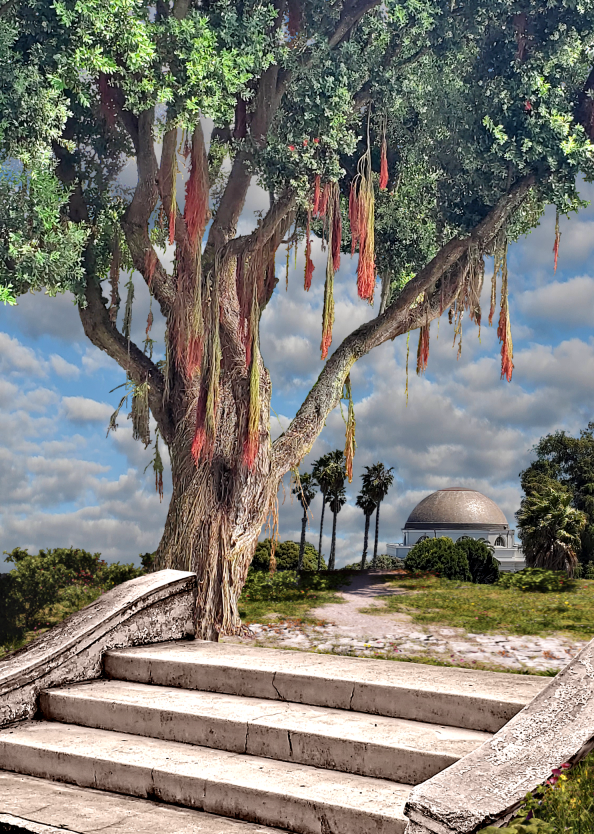
I completed the image above almost two months ago, but I did not post it until now partly because I sense it to be a departure from whatever I’ve been doing before. Or, to put it another way, it suggests to me a change has taken place, or is in progress. Something shifting in my response to the sense of mystery I relish in the world, and I’ve been at a loss about what to make of that.
The image is constructed from parts of six different photos. What kicked it off was the photo I took of the tree, which stands at the corner of Castenada and Montalvo Avenues in San Francisco’s Forest Hill neighborhood. Dr. Google tells me it is a Pohutukawa Tree, native to New Zealand, distinguished by its orange aerial roots. During the days of pleasant, meditative effort it took me to pull the tree, pretty much pixel by pixel, out of its “actual” Forest Hill background, thoughts about elements that might be arranged around it came to mind and the image above evolved.
When the assembly was complete, I liked it a lot, but I also began to feel that the aerial roots … the feature of the tree I found mysterious and had attracted me to it … seemed a bit of a distraction from what I came to feel was the overall tranquility of the scene. In my thoughts, on this occasion, the prospect of tranquility was eclipsing mystery. That awareness seemed to me to be something I needed to reflect upon, and it was still on my mind yesterday when I came upon a couple of things while cruising the web that seemed pertinent in an oblique, associative thinking, sort of way. My relationship to mystery felt a shake.
In an interview with former NY Times art critic Roberta Smith, she remarked, “Artists cannot control the meaning of their art. They can’t possibly encompass it all if they’re good. There’s stuff left over for generation after generation to deal with.” I have no pretensions to artistry. Rather I think of the stuff I do, and the way I work, as an attempt to allow my unconscious self to find expression, and sometimes permit a glimpse of an internal horizon that is at once a little more distinct, yet ever retreating … chasing meaning of a sort that seems for a moment to be in my grasp, then skips teasingly out of reach again.
In December 1882, Vincent van Gogh wrote to his brother Theo, “Sometimes I long so much to do landscape, just as one would go for a long walk to refresh oneself, and in all of nature, in trees for instance, I see expression and a soul.” I think one of the things that especially drew me to that quote is that four weeks ago I began working on another image, and again the star of the show is a tree. This time one I photographed in San Francisco’s Dolores Park. Progress is slow because the shot includes a goodly expanse of the tree’s boughs with the sky visible through a gazillion gaps in the leaves. I’ve determined that I need to punch out all patches of sky from the tree shot so that the sky in the image I’m currently thinking of placing behind the tree will show through realistically. This sky-purging process, which feels meditative and I’m enjoying immensely, will likely take several more weeks. And it’s looking like the outcome will offer tranquility transcending mystery to an even greater extent than in the image above.
Hypnopompia
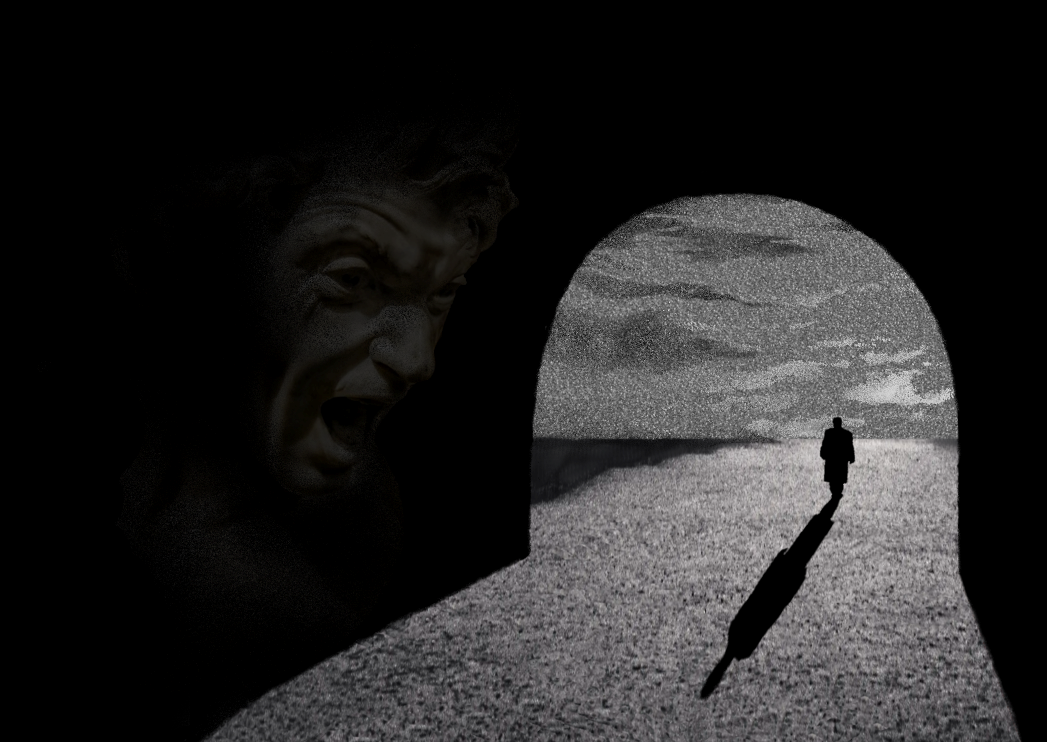
The composition above came together, first to last, during an eight-hour binge. The experience was for me, I think, sort of the graphic equivalent of automatic writing. Fragments of images and possible relationships between them presented themselves in an order that was easy to lay down. Like having stumbled upon a pleasant obscure text, I am contentedly at a loss regarding what it means.
Silhouette and Shadow
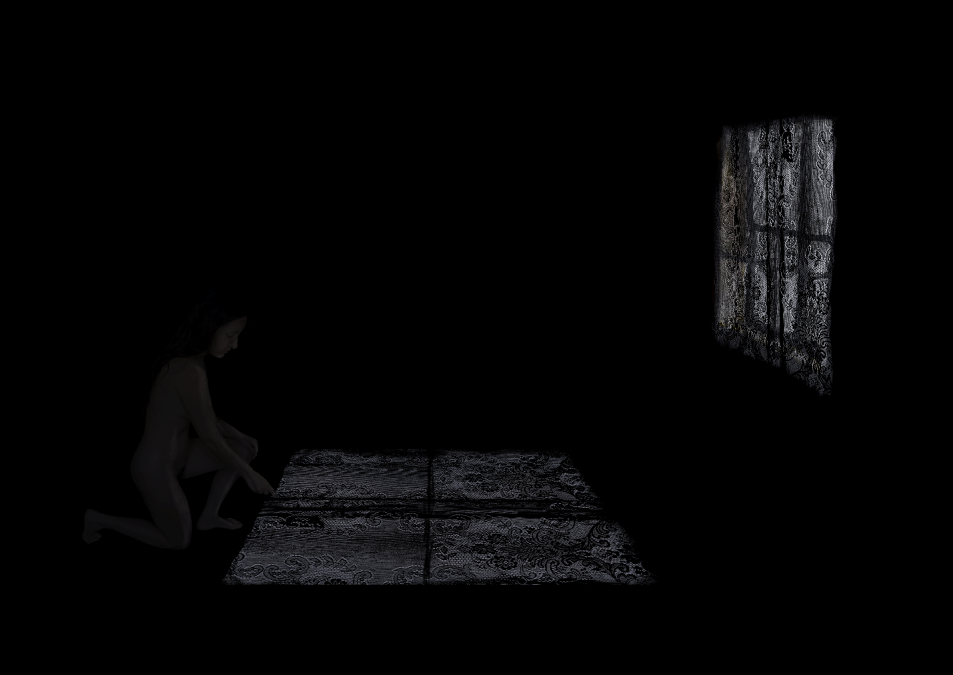
I love the way moon or lamplight through lace curtains casts gossamer shadows. Seeing evokes a sweet, calming feeling. Some graceful physical transaction is taking place that in the moment is beautiful to behold and will leave no trace when it concludes.
But wait!
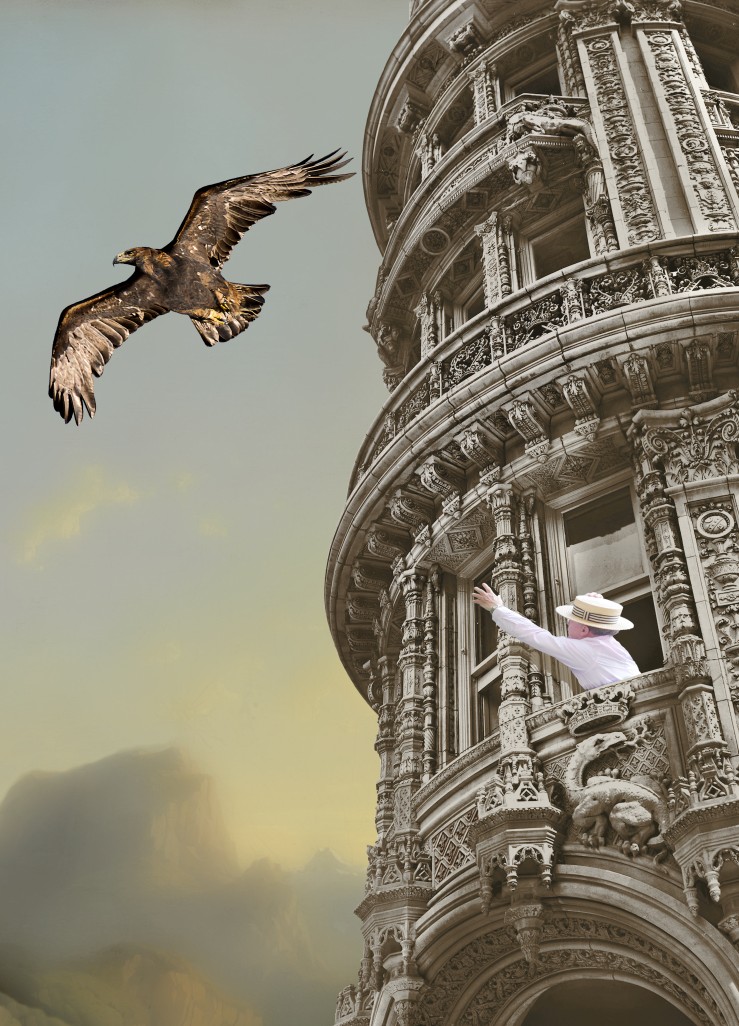
The way the image above evolved was that I came upon a public domain photo of the façade of a New York apartment building. I thought it was wonderful and began playing with a copy, trying to equalize the saturation and draw out additional details. As I proceeded, I found the open window intriguing. Stories began to occur to me. The one I was most attracted to was of something having escaped into the sky. The eagle is from a stock photo I found on the web and purchased permission to use. That’s me reaching after the bird.
Any thoughts you might care to share on this piece would be most welcome.
How long were we asleep?!
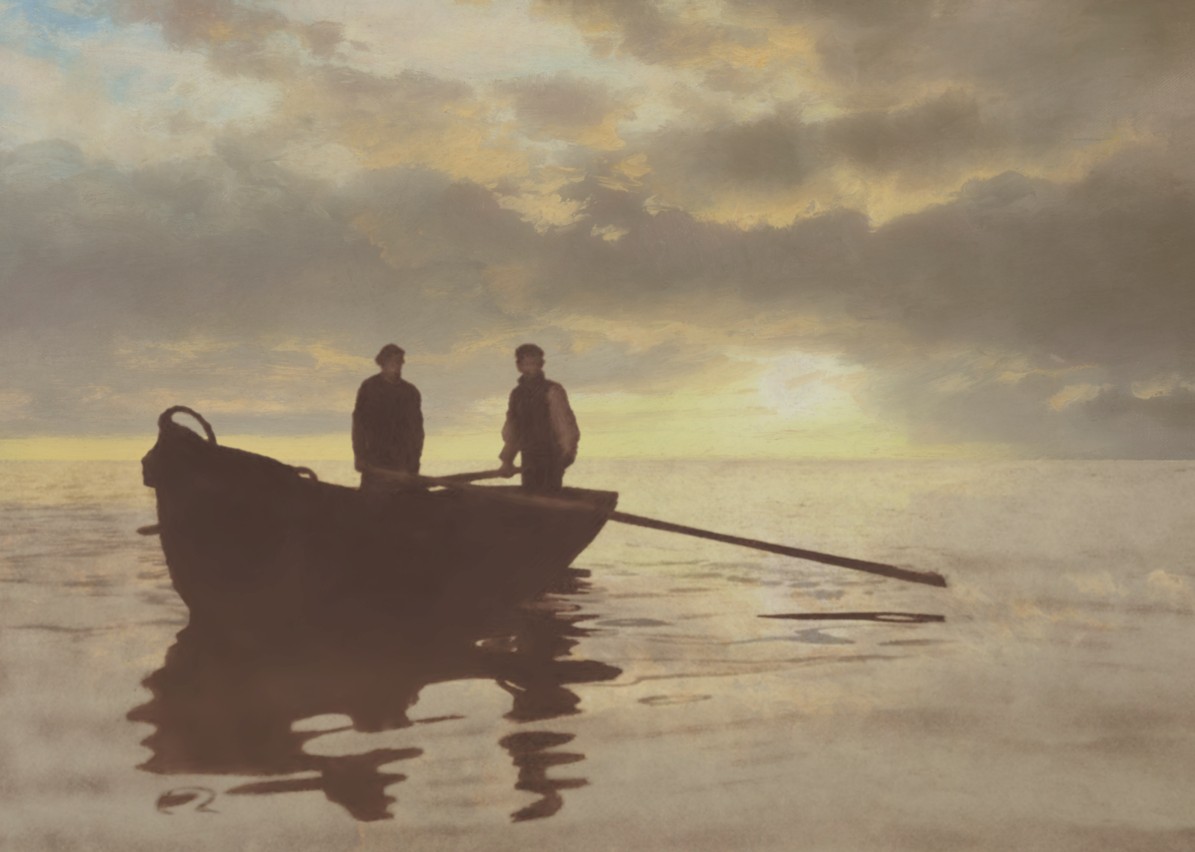
During a walk by the ocean, while thinking about some public domain material I’d come across recently on the web, a story idea came to mind. The image above is the outcome. The guys and the boat, and their reflection on the water, are from Heinrich Kuehn’s sepia-toned photo titled Venice, c. 1898. The sky and its reflection on the water are from a painting called Rhode Island Coast by William Trost Richards (b. 1833, d. 1905).
I’d be very grateful for any thoughts you might have about what I’ve done here, and how you feel about me standing on the shoulders of giants when I piece together elements of deceased masters’ works into a new image.
Ask the big floating head
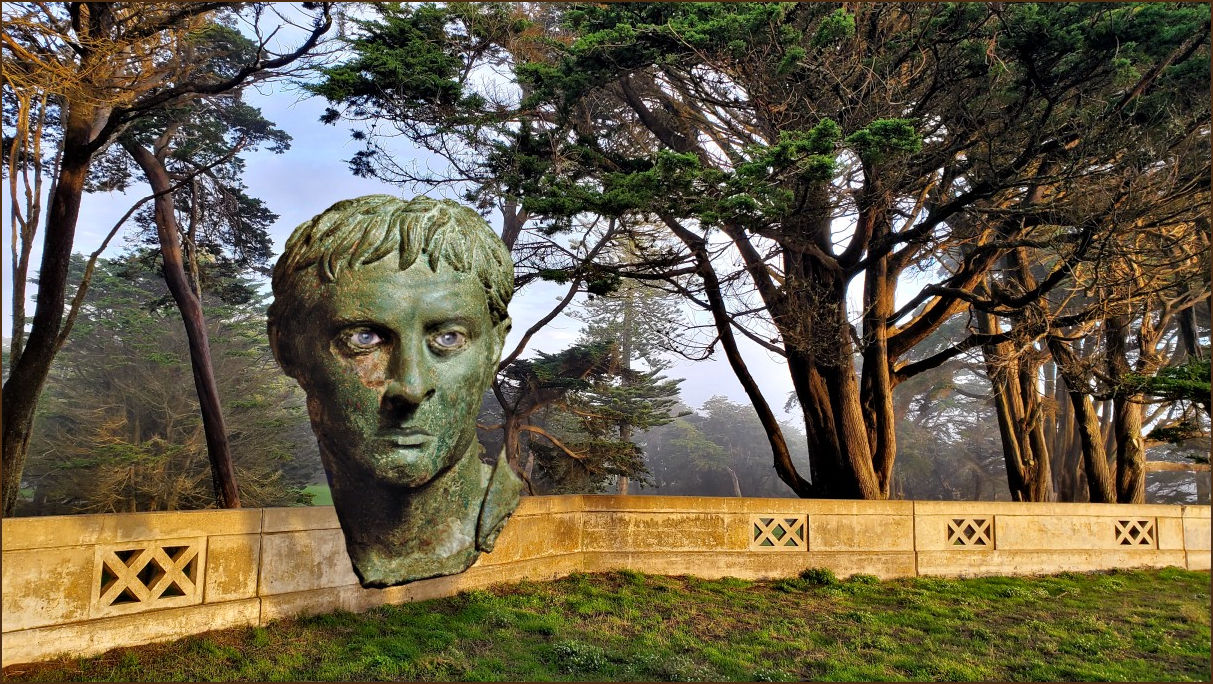
In mid-April 2025 when I posted the image above, I declared it “Untitled” and I resolved not to rattle on about it here, leaving all things related to interpretation to the viewer. But by mid-May my re-solve had dis-solved, and here the rattling begins.
I set out to try to impose my own features on a photo of a very old bronze bust. I was only partially successful, but I liked the “new” bust a lot, so I looked through pics I’d taken around town to see if I could find one that might serve as a container for the bust. I was gratified to find the pic I used as the background. Total coincidence that the light source, color tones and some of the general shapes of the background image align, at least to my eye, with some of the bust features. That’s how it happened, and I’m pleased with the composition, but no meaning or interpretation came to mind.
When I asked a dear pal what she thought the image might be about she responded, “It reminds me of older movies where there is a floating, magical bust proclaiming some kind of wisdom to protagonists who have journeyed at great peril to hear its proclamations.” I love, love, love that idea! It reminds me of Mad Magazine’s take on Herman Melville’s novel “Moby-Dick,” which they rendered as “Morbid Dick” in the June 1956 issue. The Melville novel famously begins, “Call me Ishmael.” Mad rendered it as “Call me Fishmeal.” That recollection from my childhood still delights me and I’m moved to give my image above the Mad treatment.
Jason and the guys stand in glorious Technicolor and togas before the giant floating head which intones, “For a good time, sail to the edge of the world, and if you’re not dead when you arrive, pick up a goat skin souvenir.” In response the guys enthusiastically cheer, “Yup, yup, let’s go!” … “I’m all in!” … “Sounds like a plan”… and other hearty affirmations of their acceptance of the big head’s direction. Thereafter, in light of their extraordinary agreeability — no matter the potential dire consequences — the troop was known to all as “Jason and the Argue-Nots.”
Of course, any thoughts you might wish to share … sage, shrewd, snarky or otherwise … regarding the image or my remarks above would be MOST welcome.
Or on a possibly more-serious note, here is a haiku I composed in February 2016 that may … or may not … be relevant.
see the patina
of my aging flesh and know
all that I have seen